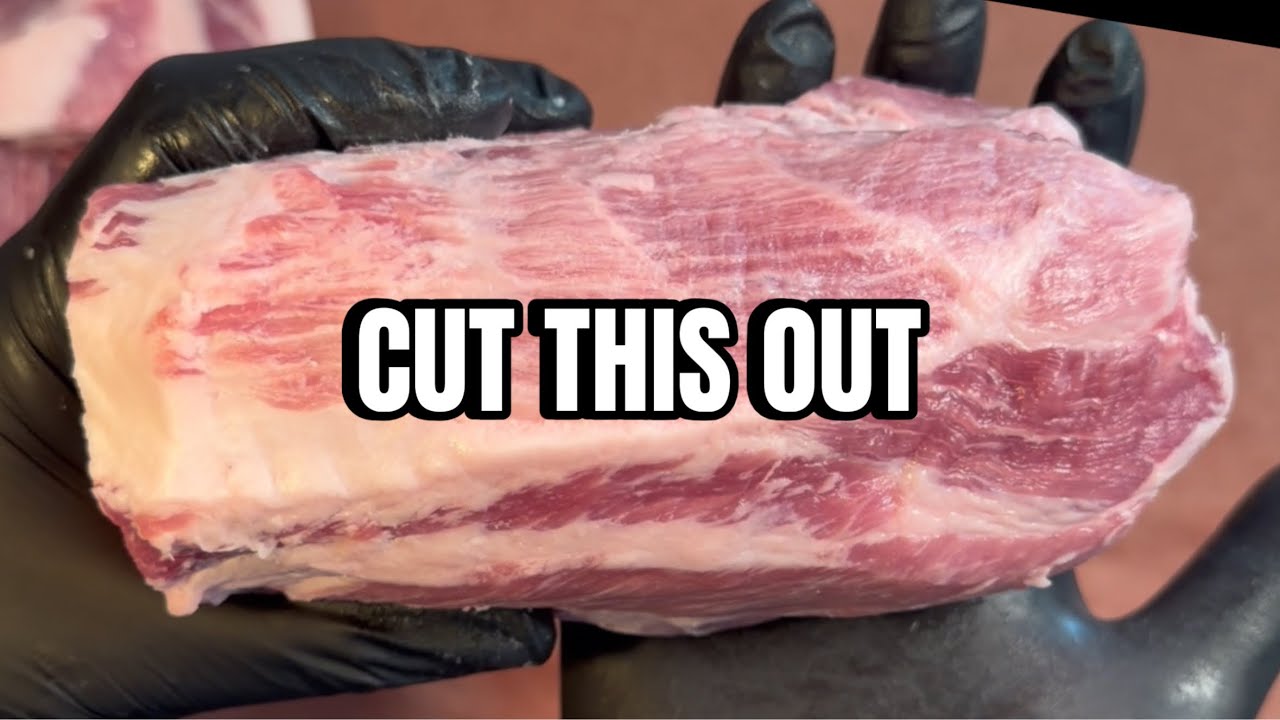
What the money muscle is
The money muscle is a cylindrical, well-marbled muscle in the pork shoulder. In Ross's description it is essentially the end portion of the longissimus, the long muscle that becomes the pork loin further along the back, where it runs into the shoulder. It sits toward one end of the butt, on the side away from the blade bone.
The name comes from its importance in competition barbecue. A well-cooked money muscle gives tender, juicy, good-looking slices, and many teams put them in their pork turn-in box. Backyard cooks use the names loosely: money muscle, pork collar and just "the collar" usually mean this piece. Butchers don't always draw the lines the same way, so a piece sold as pork collar may be cut a little differently from one you take out of a butt yourself.
Ross keeps coming back to one word for its structure: tubes. The money muscle is long, tight bundles of muscle running together with fat laced between them. That internal fat is what makes it, in his words, melt-in-your-mouth if it's cooked correctly, and the even cylinder shape is what lets it slice into neat medallions.
Taking it out yourself is the cheap way to get one. Ross's came from a $23 Costco pork shoulder, and the whole job took only a couple of minutes.
Finding it and cutting it out
On a Costco shoulder, Ross says, you can often see the money muscle right through the packaging. Look at the end of the butt for a section that looks like tight tubes running together, with fat through it: a distinct, rounded structure rather than the irregular mix of muscle that makes up the rest of the shoulder.
His first cut is at the end of the fat cap. Slicing in there opens the meat up enough to see which way the tubes run through the shoulder, which tells you where the muscle goes before you commit to a longer cut.
From there, the approach in his description is to follow the natural seams between the muscles with a sharp boning or trimming knife rather than cutting straight through the meat. The muscles of a shoulder are separated by thin layers of connective tissue and fat. Working along those seams frees the money muscle cleanly with its shape intact; cutting across them leaves ragged edges and wastes meat.
Once it's out, the job is technically done. Ross points out that you don't need to trim it at all: you could season that piece as it is and put it straight on your pellet smoker. The trimming that follows is about a better result, not a requirement.
Trimming it down to a clean cylinder
The money muscle comes out carrying a lot of fat, so Ross trims the fat cap on top and any fat running along the edges. The aim is to remove the big outer hunks so what remains is thin and will render easily. On one side of his piece the fat cap is, as he says, "a bit too intense," and that gets brought down slowly and patiently.
His reasoning is that during a low-and-slow smoke a thick outer layer of fat will render down, but it will still be there at the end. Taking it off first leaves the intramuscular fat, the fat between those tubes, to do its job during the cook. He's also clear not to overdo it: this is a very fatty cut, and some chunks of fat will stay on.
He then removes any little pieces left dangling so it's a nice cylindrical shape, and faces off the back side, meaning he cuts a straight, clean edge across the end so it looks tidy. He admits he trims it more than most people would, so treat his result as one end of the range and trim to the size and fat level you prefer.
There's an honest moment in the video: watching the footage back, Ross catches himself cutting toward his own hand and calls it out. His reminder is simple: don't cut towards yourself, always cut in the opposite direction. It's an easy habit to slip into on a small, awkward piece like this, which is exactly when a sharp knife and a patient pace matter most.
Cooking it, slicing it and using the rest
Separating the money muscle means you can cook it on its own, which gives you more control, since it's a much smaller piece than the whole shoulder and doesn't have to follow the whole butt's timeline. Ross's suggestion is to season it and smoke it low and slow. Alternatively, as his description notes, you can leave it attached, cook the whole shoulder the traditional way, and slice the money muscle out after the cook.
The video doesn't give a cooking temperature. As general guidance, pork is safe to eat at 145°F, but a shoulder muscle needs to go much higher before its connective tissue softens. Cooks commonly take it to somewhere around 190–203°F and go by how easily a probe slides in rather than a single number.
After the cook and a rest, find the direction of the muscle fibres and slice across the grain into even slices. Cutting across the grain shortens the fibres and makes each bite easier to chew. Thickness is personal preference, but even slices look much better. Ross's case for doing this at home is simple: hand a guest a pork money muscle medallion and they may not know what it is, but they'll love it.
Nothing gets wasted. Ross saves every trimming to make sausage, and calls that a must. What's left once the money muscle is out is still pork shoulder, and it can be cooked for pulled pork just as it would have been.


