Saucy Rossy BBQ
Pork

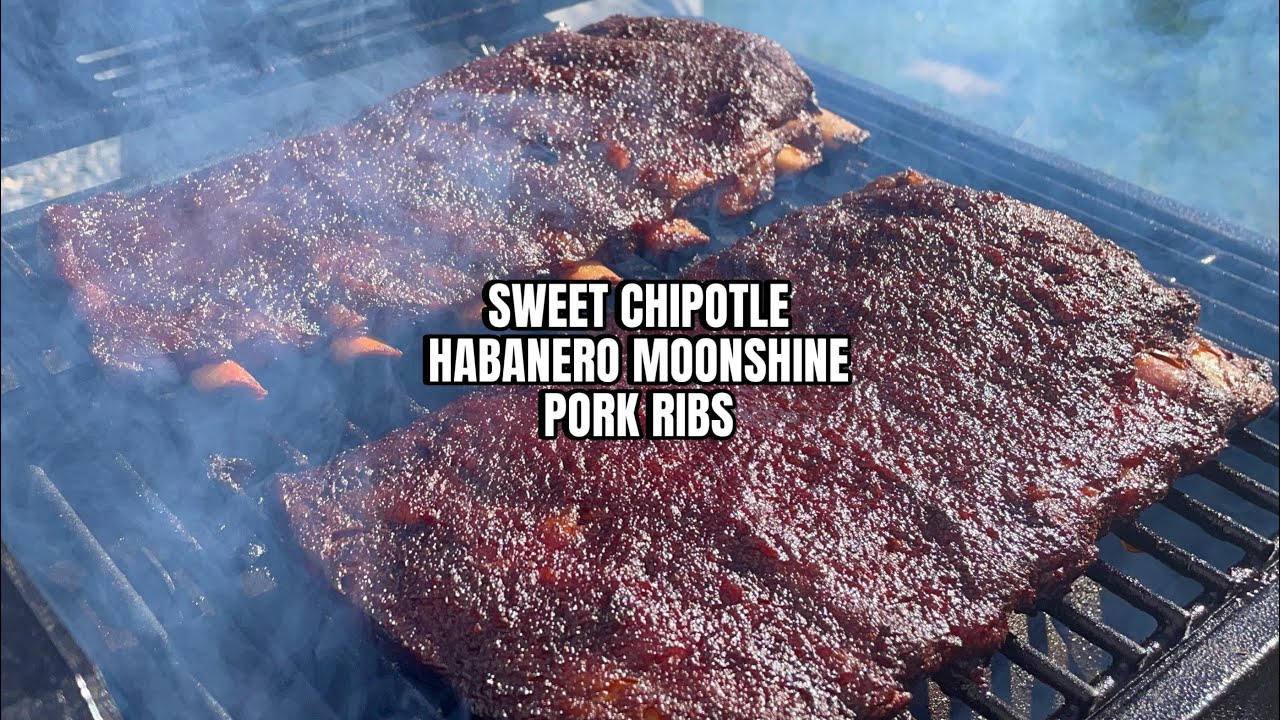
Sweet Chipotle Habanero Moonshine Pork Ribs

Pork ribs smoked in stages on a tabletop pellet smoker with Maritime Madness sweet chipotle rub and a habanero moonshine glaze for fall-off-the-bone sweet heat.
Time~6 hrs Prep15 min YieldServes 3–4 (1 rack) CategoryPork Watch7:10
Sweet Chipotle Habanero Moonshine Pork Ribs — watch on YouTube

Watch the full cook on YouTube

Method

  1. 1Season the ribs all over with Maritime Madness Sweet Chipotle Dry Rub.Pull the membrane from the bone side first — it never renders and blocks smoke and rub entirely. Season both sides generously; a sweet chipotle rub caramelises into bark over four hours.
  2. 2Smoke the ribs unwrapped on the pellet smoker for 4 hours to build a solid bark.Four hours unwrapped is a long smoke phase and it is where all the flavour and colour go on. Once the foil goes round, the ribs take on nothing more. Look for the bark set dark and firm and the bones starting to pull back.
  3. 3Wrap the ribs in foil with Habanero Moonshine Grilling Sauce and butter, then cook for 1 hour to tenderize.Lay them meat-side down onto the sauce and butter so the top surface sits in the braising liquid, and wrap tightly. An hour is where the tenderising happens — longer and they go past tender into falling apart.
  4. 4Unwrap, glaze with more Habanero Moonshine sauce, and smoke a final hour to finish strong.Open away from you; there is a lot of trapped steam. The final open hour is what turns wet sauced ribs back into sticky lacquered ones. Glaze thinly — a moonshine grilling sauce is sugar-heavy and will catch if it goes on thick.
  5. 5Rest, slice, and serve.Rest ten minutes and slice between the bones with the rack meat-side down so you can see where to cut.

Watch it on YouTube

What each ingredient is doing

Pork ribs
Spare or St. Louis cut. A St. Louis rack is squared off and cooks more evenly; untrimmed spares are cheaper with thin and thick sections that finish at different times.
Sweet Chipotle rub
Smoky heat and sugar. The chipotle reinforces the smoke from the pellets rather than competing, and the sugar caramelises into bark at 225°F.
Habanero Moonshine sauce
Sweet, fierce and high in sugar. Used in the wrap where it braises into the meat, then again as a glaze — the double application is what layers the heat rather than leaving it on the surface.
Butter
Fat for the braise. It tempers the habanero heat considerably as well as keeping the surface from drying.

Temperature guide

StageTempWhat it means
Smoke phase4 hours at 225°FUnwrapped. Bark dark and set, bones pulling back.
Wrapped1 hourFoil with sauce and butter. The tenderising phase.
Open finish1 hourGlazed. Sauce tacks up and bark firms back.
DoneBend testLift a third of the way along — it bends and the surface cracks.

Pitmaster tips

  • Remove the membrane first. It never renders and blocks smoke, rub and sauce from the entire bone side.
  • Four hours unwrapped is the whole flavour phase. Once wrapped the ribs take on no more smoke, so do not cut it short.
  • Wrap meat-side down into the sauce and butter so the top surface actually sits in the braising liquid.
  • Butter in the wrap tempers habanero heat considerably. If you find the sauce fierce, more butter is the fix rather than less sauce.
  • Cap the wrap at an hour. Ribs go from tender to falling apart quickly, and falling completely off the bone is overcooked.
  • Glaze thinly at the end. A moonshine grilling sauce is sugar-heavy and a thick coat will catch and blacken.
  • The open hour is not optional — it dries the surface and sets the glaze. Skipping it is why ribs come out soggy.
  • Open the foil away from you. A wrapped rack holds a surprising amount of scalding steam.
  • Use the bend test rather than a thermometer. Thin bone-adjacent rib meat gives unreliable readings.
  • Slice with the rack meat-side down so you can see the bones and cut cleanly between them.

If it goes wrong

The ribs fell apart
Too long in the wrap. An hour is the limit; a thinner St. Louis rack may want 45 minutes.
They are tough
Undercooked. Wrap again and give another 20–30 minutes, then test with the bend test.
The glaze burnt
Applied too thickly or too early. A sugar-heavy sauce needs a thin coat in the last stretch only.
They came out wet rather than sticky
The open hour was skipped. That hour is what sets the glaze and firms the bark.
It is far too hot
Habanero is fierce. Increase the butter in the wrap, which dilutes it considerably, or cut the glaze with a milder BBQ sauce.
The bark washed off in the wrap
Too much liquid, or wrapped before four hours of bark had formed.

Ways to change it up

Milder
Cut the moonshine sauce half and half with a mild BBQ sauce at both the wrap and glaze stages.
Butcher paper
Instead of foil, for a firmer bark at the cost of some tenderness.
No wrap
Smoke straight through for about six hours with occasional spritzing. Firmer bite, better bark.
Different sauce
Any sweet-heat sauce works. Peach, apricot or a hot honey all suit pork.
Offset or kettle
Any smoker holding 225°F. The three phases and the bend test are unchanged.

What to serve it with

  • Coleslaw and cornbread against the heat.
  • A cooling dip — ranch or sour cream — for anyone who finds the habanero fierce.
  • Pickles or pickled onions.
  • Baked beans or potato salad.
  • Cold lager or cider; both cut sweet heat well.

Storage & reheating

Cooked ribs keep 3–4 days refrigerated. Store the rack whole rather than cut into individual bones, wrapped tightly, and cool before sealing.

Reheat wrapped in foil at 250°F for 20–30 minutes with a splash of apple juice, then open for the last five minutes if you want the glaze to firm up. Avoid the microwave, which makes rib meat rubbery. Note that the heat usually reads stronger the next day as the capsaicin distributes through the fat.

They freeze well for about three months. Freeze the rack whole and wrapped, or vacuum-sealed, and thaw overnight in the fridge. The best reheat is a sealed bag in barely simmering water, which brings them back without exceeding the temperature they were cooked to.

FAQ

How do I tell when ribs are done?

The bend test. Lift the rack with tongs about a third of the way along — it should bend under its own weight and the surface should crack. A thermometer is unreliable on ribs because the meat is thin and close to bone. Falling completely off the bone means overcooked, not perfect.

Why put the sauce in the wrap as well as on at the end?

Two different jobs. In the wrap it braises into the meat, distributing the flavour and heat through the rack rather than leaving it on the surface. At the end it forms the glaze. Doing both layers the flavour in a way a single surface application cannot.

How do I make these less spicy?

More butter in the wrap is the most effective fix — fat dilutes capsaicin and tempers habanero considerably. You can also cut the sauce half and half with a mild BBQ sauce at either stage without changing the method at all.

Why is the last hour uncovered important?

Because ribs come out of the wrap wet. That final open hour lets the surface dry, the sauce tack up into a glaze and the bark firm back up. Serving straight from the foil gives you soft, soggy ribs no matter how tender they are.

Do I have to remove the membrane?

Yes, for a rack you are smoking. It is a tough silverskin that never renders, and it blocks smoke, rub and sauce from reaching the bone side. Lift a corner with a knife, grip it with a paper towel and pull — it usually comes off in one sheet.

Can I use a small tabletop pellet smoker for a full rack?

Yes, though you may need to cut the rack in half to fit it on the grate. That is not a problem — two half racks cook exactly the same way, and it actually gives you a little more bark on the cut ends.

Know your cook

More information, cause recipe back stories are stupid

No 500-word life story — just the good-to-know stuff on what’s actually in this cook. Here’s the rundown on every real ingredient, health and nutrition wise.

Pork
Pork is a protein-rich meat that's especially high in thiamine (vitamin B1) — more than most other meats — plus B6, niacin, and selenium. Tenderloin and loin are lean; shoulder and belly are richer, so portion the fattier cuts.
Chili peppers
Chili peppers are low in calories and high in vitamin C and antioxidants, and their heat comes from capsaicin, which may give metabolism a small nudge. Dial the amount to your spice tolerance.
Spirits
Spirits add deep caramel and molasses notes to sauces, and most of the alcohol cooks off, leaving the flavour behind. Enjoy the finished dish — and the drink itself — in moderation.
Butter
Butter adds richness and helps carry sauce into the meat, but it's high in saturated fat and calories, so it works best as a finishing touch rather than by the cupful.

General nutrition info only, not medical or dietary advice — portions, brands and add-ons change the numbers.

← All recipes  ·  All 38 pork recipes