Saucy Rossy BBQ
Beef

Foil Boat Smoked Brisket on a Traeger

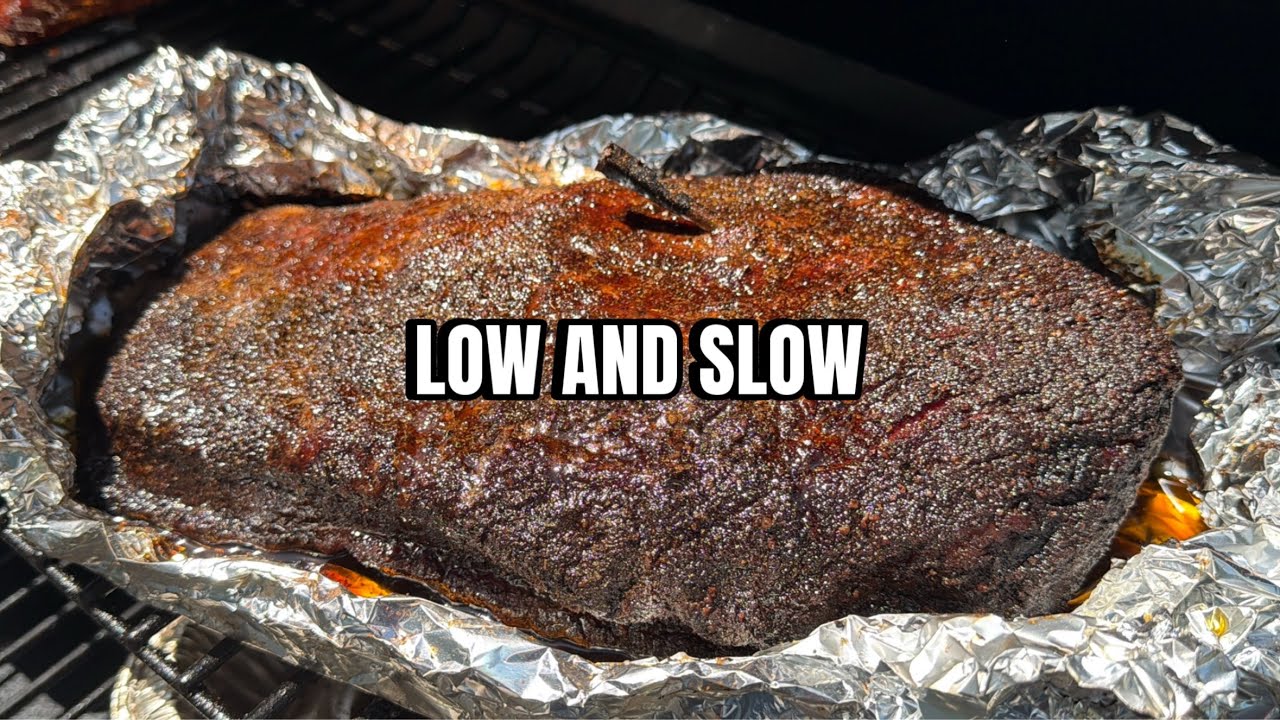
A whole packer brisket trimmed aerodynamic, seasoned with BBQ spice and coffee rub, smoked at 225°F over applewood, then finished in a foil boat that preserves the bark while the rendered fat bastes the meat.
Time~12 hrs Prep45 min YieldServes 12–16 CategoryBeef Watch10:37
Foil Boat Smoked Brisket on a Traeger — watch on YouTube

Watch the full cook on YouTube

Method

  1. 1Trim the brisket into a smooth, aerodynamic shape, leaving about a quarter-inch fat cap.Round off every thin corner and uneven edge — those cook far faster than the rest and are burnt jerky by the time the thick part is ready. Trim with the brisket cold and a sharp knife; fat firms up in the fridge and cuts cleanly, while a room-temperature brisket smears. Remove the hard deckle fat between the point and the flat, which never renders.
  2. 2Season every surface generously with Barbeque Spice and Café Ember Coffee Dry Rub.Two rubs layered: the BBQ spice for savoury backbone, the coffee for depth and colour. Coffee behaves like a dark roasted spice here — it deepens the bark and balances the fat rather than tasting of coffee. Season the sides and the flat's underside as well as the top, and be far more generous than feels right on a piece of meat this size.
  3. 3Put the brisket on the Traeger at 225°F using applewood pellets.Applewood is mild and clean, which suits a brisket carrying two assertive rubs. Fat cap up or down is a genuine debate; the important thing is the point end faces the hotter part of the grill, since it has more fat and can take it while the lean flat cannot. Load the hopper full before a cook this long.
  4. 4Smoke until the brisket reaches around 170°F internal.This is the smoke and bark phase, and it is where the stall happens — expect the temperature to sit still for a couple of hours somewhere around 150–170°F as evaporative cooling matches the heat going in. That is normal. Do not raise the temperature to fight it.
  5. 5Build a foil boat around the bottom and sides of the brisket, leaving the top exposed.This is the whole technique. A full wrap steams the bark soft; leaving the top open means it keeps drying and firming in the smoke while the foil below collects all the rendered fat and juices, so the brisket effectively sits in its own basting liquid for the rest of the cook. It is the middle ground between wrapping and running naked.
  6. 6Cook until probe tender rather than to a set number — around 198°F on this one.Probe the thickest part of the flat, which is always the last to give. The thermometer should slide in with no resistance, like into room-temperature butter. That happened at 198°F here; another brisket might need 205°F. Tenderness is the test, the number is only a guide.
  7. 7Wrap in butcher paper, pour the rendered juices back over, wrap again in foil, and rest in a cooler.Pouring the collected fat and juices back over the brisket is the payoff for the boat method — you have been catching them for hours. Preheat the cooler with hot water first and tip it out, then wrap the whole parcel in a towel. Rest 2–4 hours; resting above 140°F lets the fibres reabsorb moisture and residual collagen keep converting.
  8. 8Separate the point from the flat and slice each against its own grain.The two muscles have grains running at roughly right angles. Separate them along the fat seam after resting, turn each one, and slice across its fibres about pencil width. Slicing the whole brisket in one direction guarantees half of it is stringy.

Watch it on YouTube

What each ingredient is doing

Whole packer brisket
Both muscles together — the lean flat and the fatty point. That is what makes brisket difficult: two different cuts with different fat content and different grain directions cooking as one piece. Look for good flex and even thickness rather than the biggest one on the shelf.
Barbeque Spice rub
The savoury base layer — salt, pepper, paprika, garlic. Salt is doing the heavy lifting: on a piece of meat this size it seasons through over a long cook and helps form the bark.
Café Ember coffee rub
Ground coffee acts as a dark, bitter spice. It deepens bark colour and balances the richness of the fat, and it pairs particularly well with beef. It does not make the brisket taste like coffee — but it will turn acrid over a dirty fire, so keep the smoke clean.
Applewood pellets
Mild and slightly sweet. On a brisket already carrying two strong rubs, a gentle wood is the right balance. Oak and hickory are the traditional brisket woods if you want more smoke assertiveness.
Heavy-duty foil
For the boat, and it has to be heavy duty — thin foil tears under the weight of a packer and you lose the rendered fat, which is the entire point of the technique.

Temperature guide

StageTempWhat it means
The stall150–170°F / 66–77°CEvaporative cooling. Can last hours. Normal, and not something to fix by raising the heat.
Boat point170°F / 77°CBark is set. Build the foil boat around the bottom and sides only.
Probe tender195–205°F / 90–96°CThis one landed at 198°F. Feel matters more than the number — probe the thickest part of the flat.
Rest2–4 hoursIn a preheated cooler above 140°F. Genuinely improves the meat, not just holds it.

Pitmaster tips

  • Trim it aerodynamic. Thin corners and uneven edges cook far faster than the rest and are burnt by the time the thick part is done — rounding everything off is one of the biggest improvements available to a home cook.
  • Trim cold, with a sharp knife. Fat firms in the fridge and cuts cleanly; a room-temperature brisket smears and you cannot see what you are removing.
  • Leave about a quarter-inch of fat cap. Less and the flat has nothing protecting it through a twelve-hour cook; more and it never renders.
  • Remove the hard deckle fat between the point and the flat. It does not render at any temperature and it ends up on the plate.
  • The foil boat is the middle ground between wrapping and running naked — the top stays exposed so the bark keeps firming, while the foil below catches the rendered fat and bastes the meat.
  • Use heavy-duty foil for the boat. Thin foil tears under a packer and you lose the juices that make the technique worth doing.
  • Cook to probe tender, not to a number. 198°F worked here; other briskets need 205°F. A probe that meets resistance means it is not ready whatever the display says.
  • Pour the collected juices back over the brisket when you wrap it to rest. You spent hours catching them.
  • Preheat the cooler with hot water before the brisket goes in, and wrap it in a towel. An unlined cooler drops the temperature far faster than people expect.
  • Separate the point and flat before slicing. Their grains run at right angles and one slicing direction cannot serve both.

If it goes wrong

The temperature stopped climbing for hours
That is the stall — evaporative cooling matching the heat input. It is completely normal, it can last two or three hours, and raising the smoker temperature to fight it just dries the surface. The boat or a wrap is what pushes through it.
The flat came out dry
Either it was trimmed too aggressively, went well past probe tender, or was sliced too early. The flat is the lean muscle and it is unforgiving — leave a quarter-inch fat cap and rest properly.
The bark went soft
The boat was built too high up the sides, effectively becoming a wrap. The top surface must stay fully exposed to the smoke and airflow — that is the whole distinction.
It is tough even at 203°F
It is not done. Keep going and keep probing; some briskets need 205–208°F. Tough at temperature means undercooked, not overcooked.
Half the slices are stringy
The point and flat were sliced in the same direction. Separate them along the fat seam after resting and slice each across its own grain.
The bark tastes bitter
Coffee rub over a dirty fire. Coffee amplifies any acrid smoke. Make sure the pellet grill is burning clean and the smoke is thin, not thick and white.

Ways to change it up

Full butcher paper wrap
The Texas standard. Wrap completely at 170°F. Slightly faster and more tender than the boat, with a marginally softer bark. Both are legitimate; the boat keeps more crust.
Foil wrap (the Texas crutch)
Fastest and most tender, and the softest bark of the three. Useful if you are short on time or the brisket is running late for dinner.
No wrap at all
Best possible bark, longest cook, most moisture loss. Works better on a humid pit like an offset with a water pan than on a pellet grill.
Salt and pepper only
Coarse 50/50 SPG and nothing else — the central Texas approach. Worth doing once to taste what the beef and the smoke actually do without a rub in the way.
Hot and fast
Run at 275–300°F and expect 8–9 hours rather than 12. Noticeably less waiting and genuinely good results; slightly less smoke and a little less rendered fat.

What to serve it with

  • White bread, pickles and raw onion — the Texas plate, and it exists because the acid and the starch balance the fat.
  • Beans, potato salad or mac and cheese for a full spread.
  • The point, cubed and sauced, turned into burnt ends for a second dish out of the same cook.
  • Barbecue sauce on the side rather than on the meat, so people can judge the brisket first.
  • A dark beer or a bold red; both stand up to twelve hours of smoke and fat.

Storage & reheating

Keep brisket whole and unsliced in the fridge with its juices — it holds 3–4 days that way and only about a day once sliced, because every cut face is somewhere moisture escapes. Pour any leftover rendered fat over the top before sealing; it sets solid and protects the meat.

Reheat wrapped in foil at 250°F with a splash of beef broth or tallow until warmed through. Better still, vacuum-seal portions and reheat in barely simmering water — because the meat never exceeds the temperature it was cooked to, it comes back remarkably close to fresh off the smoker. That is worth the trouble on something that took twelve hours.

Brisket freezes for about three months. Portion it into meal-sized chunks with some of its own juices, vacuum-sealed if possible, and thaw overnight in the fridge. Do not slice thin before freezing — the extra surface area is exactly what causes freezer burn and dryness.

FAQ

What is the foil boat method?

You build a foil tray around the bottom and sides of the brisket but leave the top completely exposed. The foil catches all the rendered fat and juices so the brisket effectively bastes itself, while the open top keeps drying and firming in the smoke. It sits between wrapping — which steams the bark soft — and running naked, which gives the best bark but loses the most moisture.

How do I know when brisket is done?

By feel. Probe the thickest part of the flat — when the thermometer slides in with no resistance at all, like into room-temperature butter, it is ready. That usually falls between 195°F and 205°F, but it varies by brisket. A probe that fights you at 203°F means it needs longer.

Why trim a brisket into an aerodynamic shape?

Thin corners and ragged edges cook far faster than the thick centre, so they are dry and burnt by the time the rest is ready. Rounding everything off means the whole brisket cooks at a similar rate. It also helps airflow move smoothly over the meat rather than eddying around protrusions.

Does a coffee rub make brisket taste like coffee?

No. Ground coffee behaves like a dark, bitter spice — it deepens the bark's colour and balances the richness of the fat. What you taste is roastiness and depth. The one caution is that coffee amplifies acrid smoke, so it needs a clean-burning fire.

Which way do I slice a brisket?

Against the grain — but the point and the flat have grains running at roughly right angles to each other. Separate the two muscles along the fat seam after resting, turn each one, and slice each across its own fibres at about pencil width. Slicing the whole thing one way guarantees half of it is chewy.

Why rest brisket for hours?

Resting above 140°F lets the muscle fibres relax and reabsorb the juices heat pushed out, and any remaining collagen keeps converting to gelatin. A brisket sliced straight off the smoker loses a great deal of moisture onto the board. Two to four hours in a preheated, towel-lined cooler genuinely improves it.

Know your cook

More information, cause recipe back stories are stupid

No 500-word life story — just the good-to-know stuff on what’s actually in this cook. Here’s the rundown on every real ingredient, health and nutrition wise.

Beef
Beef is a complete protein and one of the best food sources of highly absorbable heme iron, zinc, and vitamin B12 — key for energy, immunity, and healthy blood. Fattier BBQ cuts are calorie-dense, so lean trimming and sensible portions keep it balanced.
Coffee
Coffee brings antioxidants and a bold, roasty flavour to rubs and sauces, and its natural bitterness balances sweet and smoky notes. Smoked whole beans are about aroma more than caffeine.

General nutrition info only, not medical or dietary advice — portions, brands and add-ons change the numbers.

← All recipes