Saucy Rossy BBQ
Beef

Budget Small-Batch Smoked Brisket

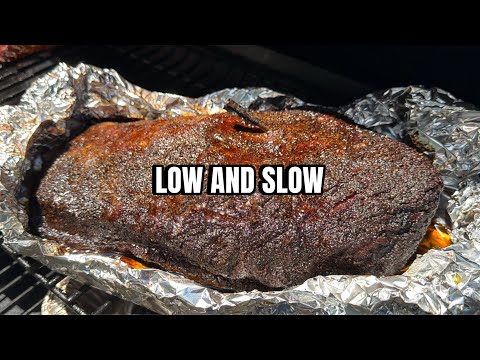
A small, budget-friendly brisket smoked on the Traeger Woodridge Pro with a foil wrap through the stall and a long cooler rest for juicy, tender slices.

Time~6 hrs Prep30 min YieldServes 6–8 CategoryBeef Watch5:45
Budget Small-Batch Smoked Brisket — watch on YouTube

Watch the full cook on YouTube

Method

  1. 1Season the small brisket with Prairie Smoke & Spice Maple Candy dry rub and their All-Purpose dry rub to build a flavourful bark.Trim cold with a sharp knife and round off thin corners. Two rubs layered gives more depth than one — the maple for sweetness and bark, the all-purpose for savoury backbone.
  2. 2Smoke on the Traeger Woodridge Pro at 225°F, then increase the temperature to 275°F after about 4 hours.225°F for the first four hours is the smoke and bark phase; the bump to 275°F afterwards is safe once the bark has set, and there is nothing more to gain from staying slow.
  3. 3When the brisket hits the stall, wrap it tightly in foil with a little margarine — beef tallow or butter work just as well.Wrap at the stall rather than at a fixed time. Margarine, butter or tallow all do the same job — adding fat and stopping the surface drying.
  4. 4Continue cooking until probe-tender, roughly 5 1/2 to 6 hours total.Probe tender beats any number. A small brisket can be genuinely done meaningfully below 203°F, so start checking around 195°F.
  5. 5Rest the wrapped brisket in a cooler for 2 to 3 hours.Preheat the cooler with hot water and wrap the brisket in a towel. Two to three hours holding above 140°F genuinely improves the meat rather than just delaying the slicing.
  6. 6Slice against the grain and serve.Separate the point from the flat and slice each against its own grain — they run at roughly right angles.

Watch it on YouTube

What each ingredient is doing

Small brisket
Harder than a big one, not easier — less mass means less thermal inertia, so it moves through the stall faster and overshoots faster. Check earlier and more often than a packer timetable suggests.
Maple Candy rub
Sweet, and it caramelises into bark at low temperatures. Layered under a savoury rub rather than used alone.
All-Purpose rub
The savoury backbone. Salt is doing the real seasoning work across a long cook.
Margarine or butter
Fat in the wrap. Beef tallow is the more traditional choice but any of the three does the same job of replacing rendered fat.

Temperature guide

StageTempWhat it means
Smoke phase225°F for ~4 hoursWhere the bark and smoke flavour develop.
Bump to275°FSafe once the bark has set. Saves real time.
Probe tender195–205°F / 91–96°CA small brisket can be done below 203°F. Start checking at 195°F.
Cooler rest2–3 hoursPreheated and towel-lined. Genuinely improves the meat.

Pitmaster tips

  • A small brisket is harder than a big one, not easier. Less mass means less thermal inertia, so it moves through the stall faster and overshoots faster — check it earlier and more often than a full packer.
  • The temperature bump from 225°F to 275°F after four hours is doing real work: the low phase is when the meat takes smoke, and once the bark has set there is nothing to gain from staying slow.
  • Probe tender beats any number. Start checking around 195°F and keep going until the probe slides in with no resistance anywhere in the flat — a small brisket can be done meaningfully below 203°F.
  • The cooler rest is not just keeping it warm. Two to three hours holding above 140°F lets the muscle fibres reabsorb juice and the residual collagen keep converting — it genuinely improves the meat rather than just delaying the slicing.
  • Wrap the brisket in a towel before it goes in the cooler, and preheat the cooler with hot water first. An unlined cooler drops the temperature far faster than people expect.
  • The point and the flat have grains running in different directions. Separate them after resting and slice each against its own grain, or half your slices will be stringy.
  • A small brisket is harder than a big one, not easier. Less mass means less buffer against temperature swings and a much faster run through the stall.
  • Preheat the cooler with hot water before the brisket goes in, and wrap it in a towel. An unlined cooler drops the temperature far faster than people expect.
  • The bump from 225°F to 275°F after four hours is doing real work — the low phase is when the meat takes smoke, and after the bark sets there is nothing to gain from staying slow.
  • Start probing at 195°F. A small brisket can be genuinely done below 203°F.

If it goes wrong

It overshot and went dry
A small brisket has less thermal mass so it moves faster than a packer. Check earlier and more often — a timetable written for a 15-pound brisket does not apply.
It is tough at 203°F
Not done. Probe feel is the test — some briskets need 208°F even at small sizes.
Half the slices are stringy
Point and flat sliced in one direction. Separate them along the fat seam and slice each across its own grain.
The cooler went cold
It was not preheated. Fill it with hot water, tip it out, then wrap the brisket in a towel before it goes in.
The bark is soft
Foil braises. That is the trade — use butcher paper if bark matters more than tenderness.

Ways to change it up

Butcher paper
Breathes rather than braises, so the bark stays firmer. Slightly longer cook.
Foil boat
Foil around the bottom and sides only. Collects the rendered fat while the bark keeps firming.
Salt and pepper only
Coarse SPG, the Texas way. Worth doing once to taste what the beef and smoke actually do.
Flat only
A brisket flat alone is even cheaper and even less forgiving — leave the fat cap and watch it closely.
Burnt ends
If your small brisket includes any point, cube it after resting, sauce and return for an hour.

What to serve it with

  • White bread, pickles and raw onion.
  • Beans and slaw.
  • Sauce on the side.
  • Chopped into sandwiches or tacos.
  • A dark beer.

Storage & reheating

Refrigerate brisket unsliced and in one piece, with any rendered juices poured over it. Sliced brisket dries out within a day; a whole chunk keeps well for 3–4 days. Reheat wrapped in foil at 250°F with a splash of beef broth or tallow, or vacuum-seal and reheat in barely simmering water — the sous-vide-style reheat is the closest you will get to fresh off the smoker.

Brisket freezes well for about three months. Freeze it in meal-sized portions with some of its own juices, vacuum-sealed if possible, and thaw in the fridge overnight. Do not slice before freezing: the extra surface area is exactly what causes freezer burn and dryness.

FAQ

Is a small brisket easier to smoke than a whole packer?

It is faster, not easier. Less mass means less buffer against temperature swings, so it moves through the stall quicker and overshoots quicker, and a small flat has less fat to protect it. Check it earlier and rely on probe feel rather than a timetable built for a 15-pound packer.

Why rest brisket in a cooler for hours?

Resting above 140°F lets the muscle fibres relax and reabsorb the juices that heat pushed out, and residual collagen keeps converting to gelatin. A brisket sliced straight off the smoker loses a great deal of moisture onto the board. Two to three hours in a preheated, towel-lined cooler is a genuine improvement, not just a holding tactic.

How do I know when brisket is done?

By feel, not by number. Probe it in several places — when the thermometer slides in with no resistance, like into room-temperature butter, it is ready. That usually lands between 195°F and 205°F, but the range varies by brisket, and a probe reading 203°F that still fights you means it needs longer.

Which direction do I slice a brisket?

Against the grain, but the point and the flat have grains running at roughly right angles to each other. Separate the two muscles after resting, turn each one, and slice each across its own fibres — about pencil width. Slicing the whole brisket in one direction guarantees half of it is stringy.

Is a small brisket easier to smoke than a whole packer?

It is faster, not easier. Less mass means less buffer against temperature swings, so it moves through the stall quicker and overshoots quicker, and a small flat has less fat to protect it. Check earlier and rely on probe feel rather than a timetable built for a 15-pound packer.

Why rest brisket in a cooler for hours?

Resting above 140°F lets the muscle fibres relax and reabsorb the juices heat pushed out, and residual collagen keeps converting to gelatin. A brisket sliced straight off the smoker loses a great deal of moisture onto the board. Two to three hours in a preheated, towel-lined cooler is a genuine improvement, not just a holding tactic.

Know your cook

More information, cause recipe back stories are stupid

No 500-word life story — just the good-to-know stuff on what’s actually in this cook. Here’s the rundown on every real ingredient, health and nutrition wise.

Beef
Beef is a complete protein and one of the best food sources of highly absorbable heme iron, zinc, and vitamin B12 — key for energy, immunity, and healthy blood. Fattier BBQ cuts are calorie-dense, so lean trimming and sensible portions keep it balanced.
Butter
Butter adds richness and helps carry sauce into the meat, but it's high in saturated fat and calories, so it works best as a finishing touch rather than by the cupful.
Beef tallow
Beef tallow is rendered beef fat used to wrap and baste — it keeps big cuts moist and adds beefy richness. It's pure fat and calorie-dense, so a light coat does the job.

General nutrition info only, not medical or dietary advice — portions, brands and add-ons change the numbers.

← All recipes  ·  All 46 beef recipes