Saucy Rossy BBQ
Beef

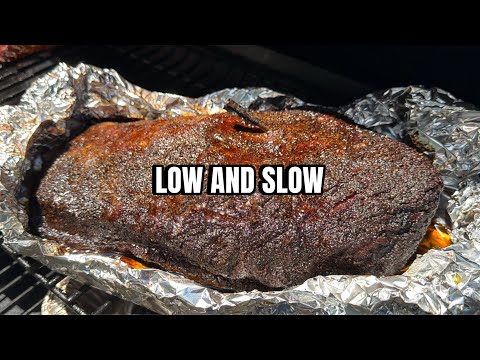
Overnight Maple Brisket on the Traeger

An overnight maple-smoked full brisket on a pellet grill — a competition practice cook with maple pellets, a maple rub, and a butcher-paper-and-tallow wrap.

TimeOvernight cook Prep45 min YieldServes 12–16 CategoryBeef Watch10:29
Overnight Maple Brisket on the Traeger — watch on YouTube

Watch the full cook on YouTube

Method

  1. 1Trim the brisket and season generously with Maple Fix BBQ Seasoning.Trim cold with a sharp knife, rounding off thin corners so nothing burns before the thick part is ready. Leave about a quarter inch of fat cap. A maple rub is sweet, and it will darken over a long cook — that is expected at 200°F, not a problem.
  2. 2Place on the pellet grill at 200°F and smoke overnight (about 7 hours).200°F is a smoke phase rather than a cooking phase. Smoke adheres best to cool moist meat, so these first hours are when almost all the flavour and colour go on. Load the pellet hopper full before bed — running dry at 3am is the classic overnight failure.
  3. 3Raise the temperature to 225°F and continue low and slow until the internal temp reaches around 175°F.The bump to 225°F once the bark has set moves things along without costing smoke you have already banked.
  4. 4Wrap in butcher paper with rendered beef tallow to preserve moisture and texture.Butcher paper breathes where foil steams, so the bark stays firm. Wrapping at 175°F rather than a fixed time matters — too early and the bark never sets, too late and you have lost more moisture than tallow can replace.
  5. 5Continue cooking until probe-tender, finishing around 204°F internal.Probe tender is the test. 204°F is where this one landed; another brisket might want 198°F or 208°F.
  6. 6Rest, then slice.Separate the point from the flat and slice each against its own grain — they run at roughly right angles.

Watch it on YouTube

What each ingredient is doing

Whole packer brisket
Both muscles together — the lean flat and the fatty point, with grains at right angles to each other. That is what makes brisket difficult and why slicing matters as much as cooking.
Maple Fix BBQ Seasoning
Sweet and maple-forward. Sugar caramelises into bark at these temperatures rather than burning, and it pairs naturally with maple pellets.
Rendered beef tallow
Added at the wrap to replace fat that has already rendered out. It keeps the outside from drying while the collagen finishes converting.
Maple pellets
Mild and slightly sweet, matching the rub. Over a 14-hour cook a strong wood on top of a sweet rub would fight it.

Temperature guide

StageTempWhat it means
Smoke phase200°F for ~7 hoursOvernight. Where almost all the smoke and colour go on.
Wrap point~175°F / 79°CBark set. Butcher paper with tallow.
Probe tender198–208°F / 92–98°CThis one finished at 204°F. Feel beats the number.
Rest2–4 hoursIn a preheated cooler above 140°F.

Pitmaster tips

  • The 200°F overnight phase is a smoke phase, not a cooking phase. Smoke adheres best to cool, moist meat, so the first several hours at low temperature are when almost all of the flavour and colour go on.
  • Trim with a cold brisket and a sharp knife. Fat firms up in the fridge and cuts cleanly; a room-temperature brisket smears and you cannot see what you are doing. Leave about a quarter inch of fat cap.
  • Butcher paper rather than foil is deliberate on a competition-style cook. Paper breathes, so the bark stays firm where foil would steam it soft — you trade a little speed for the crust.
  • Wrapping at around 175°F rather than at a fixed clock time matters. Wrap too early and the bark never sets; too late and you have lost more moisture than the tallow can replace.
  • Running overnight means running unattended, so give the pellet hopper a full load and check it before bed. Running dry at 3am on a 200°F cook is the classic overnight failure.
  • 204°F is where this one landed, but probe tender is still the test. Check the thickest part of the flat, which is always the last part to give.
  • Fill the pellet hopper completely before bed. Running dry at 3am is the single most common way an overnight cook fails.
  • Wrap at around 175°F rather than at a set time. Too early and the bark never sets; too late and you have lost moisture the tallow cannot replace.
  • Expect a maple rub to go very dark over 14 hours. That is caramelisation, not burning, at 200–225°F.
  • Trim the brisket cold with a sharp knife. Fat firms in the fridge and cuts cleanly; at room temperature it smears.

If it goes wrong

The pellet grill ran out overnight
The classic overnight failure. Fill the hopper completely before bed and check it — a 14-hour cook at low temperature still burns a lot of pellets.
The bark is soft
Foil instead of paper, or wrapped too early. Butcher paper breathes; wrap once the bark is genuinely set and dark.
It is tough at 204°F
Not done. Keep going and keep probing — some briskets need 208°F. Tough at temperature means undercooked.
Half the slices are stringy
Point and flat sliced in the same direction. Separate them along the fat seam and slice each across its own grain.
The rub burnt
A maple rub darkens a lot over 14 hours, which is normal. If it is genuinely burnt rather than dark, the grill was running hotter than set.

Ways to change it up

Foil boat
Foil around the bottom and sides only, leaving the top exposed. Collects the rendered fat while the bark keeps firming.
Hot and fast
275–300°F for 8–9 hours instead of overnight. Genuinely good results with far less waiting.
Foil wrap
Faster and more tender than paper, at the cost of a softer bark. Useful if the brisket is running late.
Salt and pepper
Coarse SPG instead of a sweet rub. Worth doing once to taste what the beef and smoke actually do.
Burnt ends
Cube the point, sauce it and put it back on for an hour. A second dish from the same cook.

What to serve it with

  • White bread, pickles and raw onion.
  • Beans, potato salad or mac and cheese.
  • Sauce on the side rather than on the meat.
  • The point turned into burnt ends.
  • A dark beer or a bold red.

Storage & reheating

Keep brisket whole and unsliced in the fridge with its juices — it holds 3–4 days that way and only a day or so once sliced. Reheat in foil at 250°F with a splash of beef broth or tallow until warmed through, or vacuum-seal and reheat in barely simmering water, which is far and away the best method for a brisket you spent all night on.

It freezes for about three months. Portion it before freezing but do not slice it thin — chunks survive the freezer far better than slices. Vacuum-seal with a spoon of the rendered fat, thaw overnight in the fridge, and reheat gently.

FAQ

Why smoke a brisket overnight at 200°F?

Smoke sticks best to cool, moist meat, so a long low phase early is when the brisket takes on most of its flavour and colour. It also spreads a 14-hour cook across hours you would otherwise be awake for — you go to bed with it at 200°F and wake up to a brisket that is most of the way through the smoke phase.

Butcher paper or foil for brisket?

Butcher paper breathes, so the bark stays firm and the brisket keeps a little of its crust; foil traps everything and effectively braises the meat, which is faster and more tender but softens the bark. Competition and Texas-style cooks generally use paper for that reason. Both get you to probe tender.

How much fat should I leave when trimming a brisket?

About a quarter inch on the fat cap. Less and the flat has nothing protecting it through a long cook; more and it never renders, so the rub sits on a layer of fat that ends up trimmed off the plate. Remove the hard deckle fat between the point and flat, which does not render at all.

What if the brisket finishes hours before I want to eat?

That is normal and it is not a problem — it is why the cooler rest exists. Wrapped and towelled in a preheated cooler, a brisket will hold above 140°F for four hours or more and will be better for it. Plan for it to finish early rather than hoping it finishes on time.

Why smoke a brisket overnight at 200°F?

Smoke sticks best to cool, moist meat, so a long low phase early is when the brisket takes on most of its flavour and colour. It also spreads a 14-hour cook across hours you would otherwise be awake for — you go to bed with it at 200°F and wake to a brisket most of the way through its smoke phase.

Butcher paper or foil for brisket?

Butcher paper breathes, so the bark stays firm and the brisket keeps a little of its crust; foil traps everything and effectively braises the meat, which is faster and more tender but softens the bark. Competition and Texas-style cooks generally use paper for that reason.

Know your cook

More information, cause recipe back stories are stupid

No 500-word life story — just the good-to-know stuff on what’s actually in this cook. Here’s the rundown on every real ingredient, health and nutrition wise.

Beef
Beef is a complete protein and one of the best food sources of highly absorbable heme iron, zinc, and vitamin B12 — key for energy, immunity, and healthy blood. Fattier BBQ cuts are calorie-dense, so lean trimming and sensible portions keep it balanced.
Beef tallow
Beef tallow is rendered beef fat used to wrap and baste — it keeps big cuts moist and adds beefy richness. It's pure fat and calorie-dense, so a light coat does the job.

General nutrition info only, not medical or dietary advice — portions, brands and add-ons change the numbers.

← All recipes  ·  All 46 beef recipes