Saucy Rossy BBQ
Desserts

Traeger Coconut Custard Squares

Creamy coconut custard with a hint of lime on a buttery graham cracker crust, baked at 350°F on the Traeger for a subtle wood-fired edge.
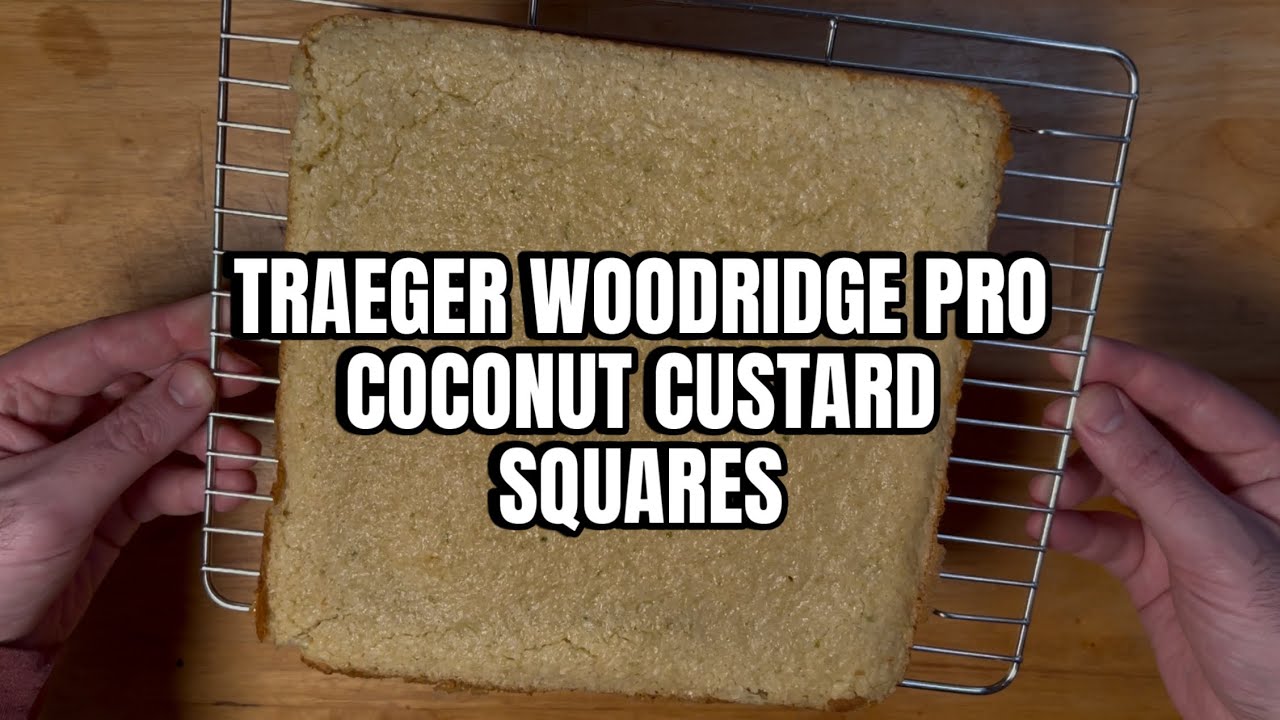
Time45 min bake Prep20 min YieldMakes 12 squares CategoryDesserts Watch3:59
Traeger Coconut Custard Squares — watch on YouTube

Watch the full cook on YouTube

Method

  1. 1Preheat the Traeger Woodridge Pro to 350°F.Preheat fully with the lid closed. A pellet grill needs 10–15 minutes to stabilise, and baking in a grill that is still climbing gives you an uneven result.
  2. 2Mix the graham crumbs, sugar, melted butter, and salt, then press firmly into an even layer in a baking dish — use the bottom of a glass to really pack it down.Pack the crust down hard with the bottom of a glass. A loosely pressed crust crumbles when you cut it and lets custard soak through underneath.
  3. 3Bake the crust for 10–15 minutes, until set — pre-baking keeps the custard from soaking through.Pre-baking is what keeps the custard from soaking into the crumbs. Ten to fifteen minutes sets it into a barrier rather than a sponge.
  4. 4Whisk together the evaporated milk, eggs, sugar, vanilla, lime zest, and salt, then stir in the shredded coconut.Whisk the eggs into the milk and sugar rather than beating air in. Custard wants to be smooth and dense, not aerated — air bubbles turn into holes as it sets.
  5. 5Pour the custard directly over the hot, pre-baked crust and return to the Traeger at 350°F.Pouring onto a hot crust gives the custard a head start at the base, which helps it set evenly rather than staying wet where it meets the crumbs.
  6. 6Bake for 30–40 minutes, until the custard is set with just a slight jiggle in the centre.A slight jiggle in the centre is the target, not a firm set. Custard continues to set as it cools, and one baked until firm will be rubbery once cold.
  7. 7Cool completely, then slice into squares and serve.Cool completely before cutting, ideally in the fridge. Warm custard will not slice cleanly no matter how sharp the knife.

Watch it on YouTube

What each ingredient is doing

Graham cracker crumbs
The crust. Packed down hard with the bottom of a glass — a loosely pressed crust crumbles when cut and lets custard soak underneath.
Evaporated milk
Not condensed. Evaporated milk is unsweetened and concentrated, which gives the custard body and richness without additional sugar. Swapping in condensed milk would make it far too sweet.
Eggs
The setting agent. Whisk them in rather than beating air in — custard wants to be smooth and dense, and air bubbles become holes as it sets.
Shredded coconut
Stirred through the custard so it suspends evenly. Some will rise and toast on top as it bakes, which is exactly what you want.
Lime zest
Zest only, not juice. Acid would risk curdling the custard, but zest brings all the aroma with none of the risk, and it cuts the sweetness.
A pinch of salt
In both the crust and the filling. Salt in a sweet dish does not make it salty; it makes the other flavours read more clearly.

Temperature guide

StageTempWhat it means
Grill temperature350°F / 177°CPreheated fully with the lid closed for 10–15 minutes.
Crust10–15 minutesUntil set. Pre-baking stops the custard soaking through.
Custard30–40 minutesUntil set with a slight jiggle in the centre.
Internal, if probing170–175°F / 77–79°CWhere egg custard sets. Past 180°F it curdles.
CoolCompletely, then chillWarm custard will not slice cleanly.

Pitmaster tips

  • Preheat the pellet grill fully with the lid closed for 10–15 minutes. Baking in a grill that is still climbing gives an uneven result.
  • Pack the crust down hard with the bottom of a glass. A loosely pressed crust crumbles when cut and lets custard soak underneath.
  • Do not skip pre-baking the crust. Those ten to fifteen minutes turn the crumbs into a barrier rather than a sponge.
  • Use evaporated milk, not condensed. Evaporated is unsweetened and concentrated; condensed would make this far too sweet.
  • Whisk the eggs in rather than beating air in. Custard wants to be smooth and dense, and air bubbles become holes as it sets.
  • Pour the custard onto the hot crust. It gives the base a head start and helps it set evenly rather than staying wet at the join.
  • A slight jiggle in the centre is the target, not a firm set. Custard continues to set as it cools, and one baked firm will be rubbery cold.
  • Zest only, no lime juice. Acid risks curdling the custard, while zest brings all the aroma with none of the risk.
  • Salt in both layers. It does not make a sweet dish salty — it makes the other flavours read more clearly.
  • Cool completely, ideally in the fridge, before cutting. Warm custard will not slice cleanly whatever knife you use.

If it goes wrong

The custard is watery in the middle
Underbaked. Give it longer — you want a slight jiggle, not a liquid centre.
The custard is rubbery
Overbaked. Egg custard sets around 170–175°F and curdles past 180°F. Pull it while it still jiggles slightly.
The crust is soggy
Not pre-baked, or not packed firmly enough. Both steps exist to stop custard soaking in.
The squares fall apart when cut
Cut warm, or a loose crust. Chill completely first and pack the crust hard.
The custard curdled
Too hot, or lime juice went in. Hold 350°F and use zest only.
There are holes through the set custard
Air beaten into the eggs. Whisk gently to combine rather than aerating.

Ways to change it up

Lemon instead of lime
Same technique, a slightly sharper result. Zest only, either way.
Toast the coconut
Toast half of it first for a deeper, nuttier flavour and more contrast.
Chocolate base
Chocolate cookie crumbs instead of graham for the crust.
Oven instead
Identical at 350°F in a conventional oven. You lose the faint wood note and nothing else.
Add a smoke layer
Run the grill at 225°F for 20 minutes with the dish on before raising to 350°F.

What to serve it with

  • Chilled, cut into squares.
  • Whipped cream on top.
  • Extra lime zest over.
  • Toasted coconut scattered on.
  • With coffee, after dinner.

Storage & reheating

Coconut custard squares keep 4 days refrigerated in a covered container. They must be refrigerated rather than left out — this is an egg and dairy custard, not a shelf-stable bake.

They firm up in the fridge and are honestly better on day two, once the custard has fully set and the flavours have settled. Cut them cold with a sharp knife wiped clean between cuts.

They do not freeze well. Egg custard weeps water on thawing and the graham crust goes soft, so the texture is noticeably worse. Better to make a half batch than to freeze the rest.

FAQ

Can I use condensed milk instead of evaporated?

No — they are quite different. Evaporated milk is unsweetened and concentrated, providing body and richness. Sweetened condensed milk carries an enormous amount of sugar, and substituting it would make these squares cloying and change how the custard sets.

Why pre-bake the graham crust?

So it becomes a barrier rather than a sponge. Ten to fifteen minutes sets the butter and sugar into a solid layer that custard sits on top of, instead of soaking straight into loose crumbs and going soggy underneath.

How do I know when the custard is done?

It should be set around the edges with a slight jiggle in the very centre when you nudge the dish. Custard continues to set as it cools, so one baked until firm in the oven will be rubbery once chilled. If you want a number, 170–175°F internal.

Why zest and not lime juice?

Acid can curdle a custard, splitting the egg proteins and giving a grainy texture. Zest carries all the aromatic oils and none of the acid, so you get the lime flavour with no risk to the set.

Why did my custard come out rubbery?

Overbaked. Egg proteins set around 170–175°F and begin squeezing water out and curdling past 180°F. On a pellet grill, temperature swings can push it there without warning, so check earlier than the recipe time suggests.

Can I bake this in an oven instead?

Yes, identically at 350°F. The only difference is the faint wood note the pellet grill contributes, which is subtle in a sweet custard anyway. Everything else about the recipe stays the same.

Know your cook

More information, cause recipe back stories are stupid

No 500-word life story — just the good-to-know stuff on what’s actually in this cook. Here’s the rundown on every real ingredient, health and nutrition wise.

Citrus
Citrus brightens rich, smoky food and brings vitamin C and antioxidants along with its acidity. A squeeze at the end cuts fattiness and lifts flavour without added salt or sugar.
Butter
Butter adds richness and helps carry sauce into the meat, but it's high in saturated fat and calories, so it works best as a finishing touch rather than by the cupful.
Salt
Salt is essential for seasoning and, in brines and cures, for texture and safety — but sodium adds up fast in BBQ. Season with intention and balance salty cooks with fresh sides.
Sugar
Sugar balances salt and heat and helps build bark and glaze, but it's a source of empty calories — rubs and sauces use it for flavour and browning, so a little goes a long way.
Coconut
Coconut adds richness and fibre, and it's high in saturated fat, so like other rich ingredients it's best enjoyed as a treat.
Eggs
Eggs are an inexpensive source of complete protein and provide choline, vitamin D, and B12, with most of the nutrients held in the yolk.

General nutrition info only, not medical or dietary advice — portions, brands and add-ons change the numbers.

← All recipes  ·  All 3 desserts recipes